
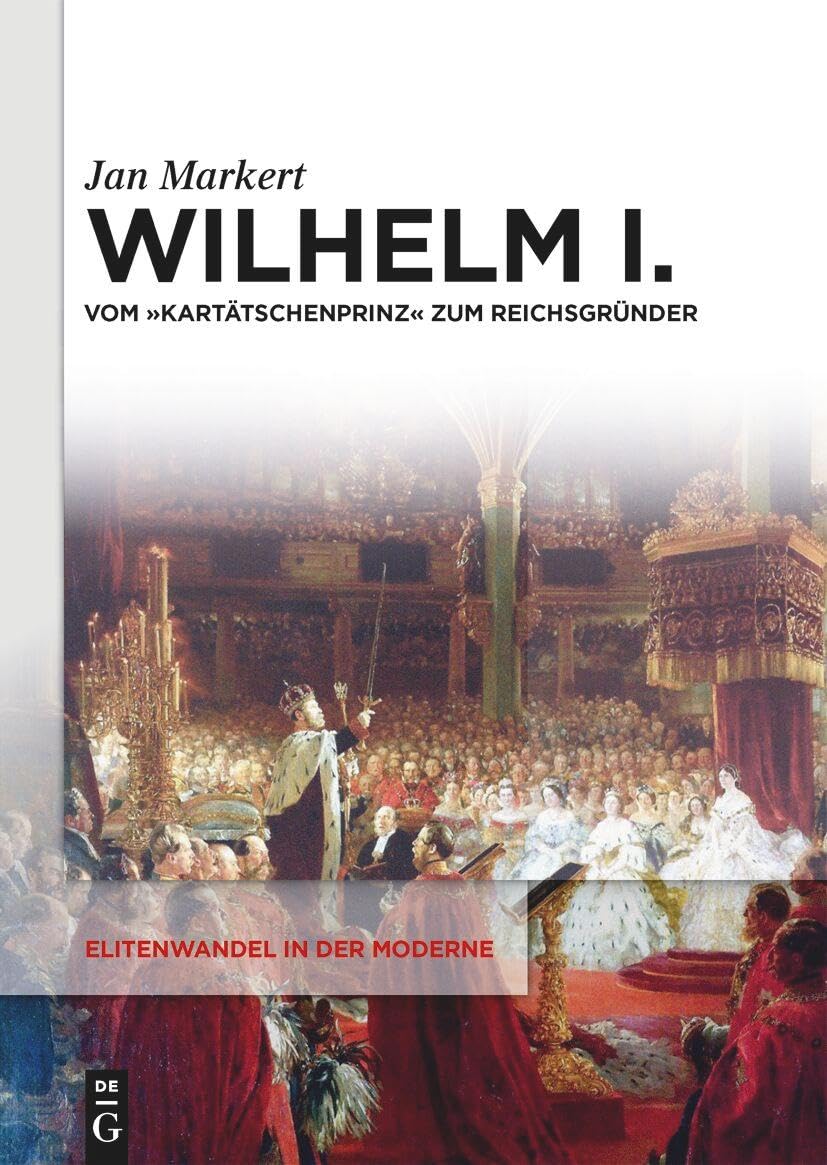
Reviewer Robin Simonow - Hochschule Fulda
Citation

Jan Markert aims to revise Prussian and German history and deliver historical justice for Wilhelm I, whom he argues has unjustly remained in Bismarck’s shadow due to a lasting «chronic Bismarck problem» that persists in research to this day. Markert discredits this as «modern, supposedly critical historiography» plagued by «Bismarck-centrism» and even «Bismarck-worship» (pp. 3 f.). He claims previous accounts of Wilhelm’s life fail to meet scholarly standards, especially due to inadequate archival research on Wilhelm’s papers. Unlike previous scholars, Markert promises systematic, meticulous research in his brief introduction of just over seven pages (pp. 4 f., 8 f.).
Markert’s focus is on Wilhelm’s private correspondence, claiming to have analyzed 9,310 letters, including 6,930 unpublished or misrepresented ones, although he does not provide any specific examples. Despite this claim, he primarily uses already published letters, citing 706 edited, 463 historian-made copies, and only 12 original letters, although not all of these were unknown. The reviewer’s particular interest in the correspondence between Wilhelm and August von der Heydt led to the disappointing discovery that, although the file was listed as a source, it was not used, reflecting a pattern that applied to about one in seven files.
Markert doesn’t cover Wilhelm’s entire life but spans over 70 years, trying to dismantle the long-deconstructed myth of Bismarck as the larger-than-life «founder of the Reich». He claims Wilhelm, not Bismarck, was key to Germany’s rise, driven by fear of revolution to devise a «coherent, consistent, and persistent agenda» (p. 227). This allegedly culminated in a «multi-level project» (p. 715) aimed at consolidating Hohenzollern rule while averting revolution. When Wilhelm assumed regency in 1858, Markert claims he began implementing this agenda through a «personal regiment» (p. 397), yet he uses the term without referencing Karl Heinz Börner’s 1984 biography,[1] which had previously employed the concept on Wilhelm I. From 1862, Bismarck, according to Markert, served merely as a tool for Wilhelm’s will. The nuances of political interactions, such as persuading, negotiating, influencing, and manipulating, are overshadowed by Markert’s portrayal of Wilhelm as the central and sole decision-maker. To bolster this view, Markert frequently stresses the truism of the prime minister’s dependency on the king’s favor, thereby reducing their dynamic to that of ruler and subject (pp. 527 f., 651, 668, 694, 697, 703 f., 719).
Overall, Markert depicts Wilhelm as «Wilhelm the Great», not only a king and military man but also a puppeteer, astute politician, and statesman who was immune to influence, persuasion, or deception, strategically navigating tumultuous political waters domestically and internationally, avoiding rash maneuvers and knowing how to correct strategic missteps in time. This aligns with his repeated use of «Allerhöchster», a term used submissively by subjects to refer to the king, from the contemporary source language (pp. 397, 453, 460, 466, 472, 490, 498, 500). Wilhelm would likely commend this posthumous portrayal, reflected in his repetitive, self-important statements. Markert dedicates extensive space to these, with over 150 lengthy quotes alone, each ranging from eight to 18 lines (pp. 74, 191, 211, 262, 292, 492, 520, 569, 601, 637, 683, 686, 711), yet fails to provide the necessary critical assessment.
Eckart Conze has already critiqued Markert’s «excessive revisionism» as counterproductive to his aim for a «total revision» (p. 719).[2] In addition, Markert himself undermines his credibility by presenting known sources as newfound discoveries fitting only his narrative. This often gives the impression he is the first to draw ideas from these sources, due to his phrasing and lack of or sporadic references to existing literature, which he also misrepresents. This is particularly evident where his interpretation of Wilhelm confronts established research, as exemplified by the September crisis of 1862. Markert accuses many historians of «uncritically» «copying» Bismarck’s memoirs, perpetuating a narrative of Bismarck as a «messianic savior» who «saved» the crown and gained «political carte blanche» (p. 507, 518). By accusing his predecessors of methodological flaws, Markert largely avoids directly engaging with their arguments.
It is evident that Lothar Gall, one of the historians Markert criticizes, conducted a historically critical, precise, and careful analysis of Bismarck’s narrative. Markert’s claims that Gall even vaguely suggested «carte blanche» or Wilhelm’s straightforward subordination to Bismarck are entirely inaccurate.[3] It is bizarre that Gall’s work is not only misrepresented, but his research efforts are also unacknowledged. In his Bismarck biography, Gall emphasized how Bismarck initially underestimated the king’s intransigence and the resistance he faced, as well as his ongoing efforts to maintain Wilhelm’s favor after his appointment. Markert draws on these insights extensively, dedicating an entire chapter (pp. 524–541) to underscore Wilhelm’s autonomy without crediting Gall. Since Markert engages less with existing research and more with Bismarck’s memoirs, he easily highlights their weaknesses, even debunking the «periculum-in-mora» legend first refuted by Egmont Zechlin nearly a century ago (p. 517).[4] Nevertheless, Markert, more than he acknowledges, relies heavily on the sources, structure, and interpretative insights of the remarkably perceptive Kurt Promnitz (pp. 518 f.).[5]
It is equally puzzling that Markert begins his supposed reinterpretation of the September 1862 crisis with the well-known account of Bismarck being considered by the king during the early summer of 1862. He presents this aspect as novel despite it being addressed by researchers for nearly a century, whom he criticizes without acknowledgment (pp. 507-509). Markert fails to mention that much of what he offers as corrections was already recognized by these so-called «uncritical» historians, notably Bismarck’s tactic of telling Wilhelm what he wanted to hear to secure his appointment (pp. 520 f.).[6] Furthermore, only those familiar with Wilhelm Treue’s work can discern that Markert’s depiction of Wilhelm’s actions and his allegedly feigned readiness to abdicate are heavily reliant on Treue, who is merely cited in a distant footnote and is not clearly linked to Markert’s preceding narrative (p. 518).[7] Markert disregards longstanding debates on Wilhelm’s willingness to abdicate, devoting only two sentences to his abdication document (p. 520). Wilhelm’s numerous statements on conditional abdication are either portrayed as strategic maneuvers (pp. 514 f., 516 f., 519 f.) or omitted entirely, such as in a letter from Alexander von Schleinitz to Queen Augusta (p. 517). Markert leaves no room for doubt regarding Wilhelm’s complete control during the September 1862 crisis.
To unsuspecting readers, Markert presents well-known sources as if they were new discoveries, purportedly offering eye-opening insights. For example, the marginal note on the State Ministry report from September 21, 1862, where Wilhelm withdrew his abdication after speaking with Bismarck, is presented as novel, despite its 96-year familiarity (pp. 519 f.). Similarly, Wilhelm’s letter to Augusta dated September 23, 1862, known for 95 years, receives the same treatment. Markert fails to acknowledge that these sources have been thoroughly reviewed and well-integrated into historical discourse on Wilhelm and Bismarck’s relationship for almost a century. Additionally, he interprets an undated note by Wilhelm, written in pencil and consisting only of bullet points, as a «government program» that purportedly imposed a «programmatic straight-jacket» on Bismarck (pp. 520, 523). This mirrors Andreas Kaernbach’s cautious thesis from 1991 based on the same source. Markert minimally acknowledges Kaernbach’s contributions and neglects crucial aspects like material and context, avoiding meaningful comparisons with previous programs. Whether Bismarck or Wilhelm referenced this alleged «government program» in their disagreements is unaddressed; instead, Markert cites vague third-party statements (pp. 520 f.). On top of that, he omits key points like «no Jews as judges» from this supposedly significant «government program.»[8]
Particularly challenging for non-specialists are Markert’s arguments, which initially seem plausible but crumble under closer scrutiny of the sources. For example, Markert attempts to demonstrate royal governance and decision-making authority by claiming that Wilhelm ordered Bismarck, in the council of October 5, 1862, to declare the regime without a budget in his own name rather than the king’s, supposedly carried out by Bismarck on October 13 (p. 529). However, Markert not only misinterprets the council minutes – it was not about declaring a regime without a budget, and Bismarck was instructed to issue a statement in his name but not that of the government – but also incorrectly associates this instruction with the wrong speech, despite editor Rainer Paetau’s clear explanations. In fact, Bismarck defied the royal instruction on October 7 by explicitly stating in Parliament, «not solely in my own name but in that of the State Ministry.»[9] Thus, the event directly contradicts Markert’s claim.
Markert initially promised systematic and meticulous research, aiming to set himself apart from predecessors in Prussian and German history. However, he fails to deliver on these promises. Thoroughness and transparency are crucial for scholarly credibility, yet his book is rife with overstatement and poorly substantiated arguments. Although its accessible main theses make it an easy read, the sheer volume of monotonous Wilhelm quotes becomes tedious. The cross-references to other European monarchies provide some research value. Nevertheless, readers who can navigate the frequent biting polemics and sensationalism, and who are not deterred by the outlined criticisms, might still find it interesting. It remains perplexing why an academic thesis, published in a respected series and aimed at revising interpretations by an allegedly «Bismarck-worshiping» profession, would skimp on a comprehensive scholarly apparatus and solid engagement with the research it aims to challenge.
This review originally appeared in German in the «Jahrbuch zur Liberalismus-Forschung» and has been abridged (https://www.recensio.net/rezensionen/zeitschriften/jlibf/2025/1/wilhelm-i-vom-kartaetschenprinz-zum-reichsgruender).
[1] Kaiser Wilhelm I. 1797–1888. Deutscher Kaiser und König von Preußen. Eine Biographie, Köln, Pahl-Rugenstein, 1984.
[2] «Frankfurter Allgemeine Zeitung», 62, 14.3.2025, p. 12.
[3] Cf. Lothar Gall, Bismarck. Der weiße Revolutionär, Frankfurt a.M., Propyläen, 1980, pp. 244–247.
[4] Egmont Zechlin, Review of: Bismarck, Die Gesammelten Werke. Politische Schriften. Bd. 3, bearbeitet von Herman von Petersdorff. Berlin 1925, in «Historische Zeitschrift», 138/2, 1928, pp. 383-388: 387 f.
[5] Cf. Kurt Promnitz, Bismarcks Eintritt in das Ministerium, Berlin, Verlag Emil Ebering, 1908, pp. 225-235.
[6] Cf. e.g. Erich Eyck, Bismarck. Vol. 1, Erlenbach-Zürich, Rentsch, 1941, p. 416; Otto Pflanze, Bismarck. Vol. 1, München, C.H. Beck, 1997, p. 181.
[7] Cf. Wilhelm Treue, Wollte König Wilhelm I. zurücktreten?, in «Forschungen zur Brandenburgischen und Preußischen Geschichte», 51, 1939, pp. 275-310.
[8] GStA PK, VI. HA, Nl Karl Ludwig Zitelmann, Nr. 2, Bl. 15.
[9] Cf. Rainer Paetau (ed.), Die Protokolle des Preußischen Staatsministeriums 1817–1934/38, Vol. 5, Hildesheim-Zürich-New York, Olms-Weidmann, 2001, No. 258; Stenographische Berichte über die Verhandlungen des Preußischen Hauses der Abgeordneten. 7. Legislaturperiode, 1. Session, Vol. 4, Berlin, W. Moeser, 1862, p. 2127 (quote).
Annali.Reviews.Online gives authors the opportunity to respond to reviews. According to ARO's “Codice Etico,” the reviewers are responsible for their own contributions.
Below is Jan Markert’s response.
In my book, I invite the research community to engage with my theses critically (pp. VII–VIII, p. 9). Robin Simonow has heeded this call. However, as he accuses me of intent to deceive in my handling of literature and primary sources, and implicitly criticises the reviewers of my doctoral thesis as well as the editors of the ‘Elitenwandel’ series it was published in, I do not wish to leave these allegations without comment.[1]
According to Simonow, my work is based on a significantly smaller body of archival sources than I claim, which, moreover, is already largely known to historians. I am also said to have tacitly adopted my theses from earlier works. And he accuses me of failing to maintain a critical distance from my research subject. I doubt that my book can be seen as a revival of the ‘Wilhelm the Great’ myth, for I repeatedly attribute to him an inability to learn and an aversion to compromise that bordered on a denial of reality, in which he was encouraged and, indeed, manipulated by those around him (e.g. pp. 54, 111–113, 132, 154–155, 274, 279–280, 425, 452–455, 503–506, 538, 586–587, 629–630, 634, 651–652).
As I emphasise in my book (p. VII), I had to shorten my dissertation from over 1,000 pages to fewer than 800 pages for publication. These edits primarily concerned quotations from primary sources as well as a detailed analysis of the research literature. For this reason, in the introduction I refer to supplementary publications (pp. 3, 5, 7–8), in which I deal in detail with previous works on Wilhelm and the problematic aspects of the source materials, and provide a footnote-by-footnote critique of the extensive literature on Bismarck.
Simonow criticises me for not citing from all the listed archive files, and for failing to cite the vast majority of the approximately 9,310 documents written by Wilhelm between 1797 and 1888 that I researched during my PhD studies. The list of archival sources used is not a list of archival sources cited. In fact, the majority of the documents proved to be irrelevant to my specific research questions. In order to identify the relevant sources, to ascertain what Wilhelm communicated to his correspondents, and to formulate well-founded statements regarding the sources’ silence on certain topics (e.g. pp. 207, 364, 464, 499, 528, 547, 611, 623), I also had to analyse these sources. This is why they are included in the list.
As a significant portion of the original archival estate was lost during World War Two, the transcriptions of letters I cite – which are also cited by Susanne Bauer and Frederik Frank Sterkenburgh – often represent the only means of filling the gaps in the historical record. Before I decided to use these transcripts, I first had to convince myself of their accuracy (p. 9). In my current project, born out of this research, I am editing Wilhelm’s correspondence with Augusta, and can now confirm that initial assessment letter by letter. Via https://augusta-wilhelm-briefwechsel.uni-trier.de/home, everybody can read the archival and publication history of these letters, as well as verify my theses against the original documents. I would be grateful if this material were used for further, supplementary or contrasting studies on the first Kaiser.
I was also able to compare printed documents with the originals. The file cited by Simonow concerning the letters between Wilhelm and August von der Heydt, from which I do not quote, contains 16 letters from the king, 15 of which have already been published in full. The sole unpublished letter is a two-page instruction on changing the design of a medal. A thoroughly surprising finding of my research was that many of the printed sources contradict established scholarly narratives, yet have so far received little or no attention, just like the few archival documents already cited in the older literature (e.g. pp. 563–569, 607–609, 677–688).
Simonow outlines his accusation that I adopt the theories of other historians in detail in relation to my reconstruction of Bismarck’s appointment, focusing mainly on my treatment of Lothar Gall’s biography of Bismarck. This work serves as a prime example of what I criticise as ‘Bismarck-centrism’. Gall does not use any archival sources. This is problematic where he relies on Bismarck’s memoirs as the supposedly sole surviving source, as is the case with the events of 22 September 1862. Gall does, admittedly, write that Bismarck’s account is ‘a masterpiece of political myth-making’. Yet at the same time he claims that Bismarck ‘essentially accurately recounted’ the events, and that no other accounts exist.[2] As early as 1949, Arnold Oskar Meyer quoted excerpts from Wilhelm’s letter of 23 September 1862[3], which I discuss in detail (pp. 519–521). Gall refers to Meyer’s quotations in a different context, without establishing the link to Bismarck’s appointment. Since Gall also writes that Wilhelm granted Bismarck ‘almost complete political freedom’ in 1862[4], Simonow’s accusation that I tacitly follow Gall comes as a surprise, given that I argue the opposite (p. 524).
Kurt Promnitz also regards Bismarck’s memoirs as factual accounts.[5] In contrast, Wilhelm Treue argues that Bismarck’s appointment was a coup deliberately orchestrated by Wilhelm[6] – a thesis with which I do not agree (pp. 508–512), which is why I refer to Treue solely in connection with his criticism of Bismarck’s memoirs (p. 518). Finally, Karl-Heinz Börner characterises the monarch as a mere figurehead for a ‘Junker class’ and a ‘military party’ ruling from behind the scenes, before Bismarck took the reins in 1862.[7] As Simonow also criticises me for failing to address Wilhelm’s attitude towards Jews in my analysis of the 1862 government programme, I would like to draw attention to a supplementary publication in which I write on this topic.[8]
I do not deny that the sources I have used can also be interpreted differently. Whilst Bismarck’s term in office does, historiographically speaking, overshadow Wilhelm’s reign, it is merely one aspect of this monarch’s biography, which I use as an example to analyse the ambivalent role of the monarchical system as both a driving force behind and a hindrance to state modernisation in the 19th century. Consequently, it is not the year 1862 that forms the analytical linchpin of my book, but the Revolutions of 1848/49. Wilhelm’s reign serves as an example of the responses monarchical actors were able to devise to the challenge posed by nationalism – one of the central theses of my book. Drawing on a broad body of sources, I argue that, contrary to traditional scholarly narratives, the first Kaiser did not need to be dragged into the German nation-state. This argument is also supported by Frederik Frank Sterkenburgh’s research. However, depending on the choice of sources and research questions, other historical individuals and structures may also be given greater weight – a point I would, of course, like to emphasise. For debates and controversies help to broaden research perspectives and put traditional narratives to the test. Our discipline can only benefit from this.
[1] The dissertation was awarded ‘summa cum laude’ by all three examiners, and I successfully defended it with this distinction.
[2] Lothar Gall, Bismarck. Der weiße Revolutionär, Frankfurt et al. 1980, pp. 240, 244–25.
[3] Arnold Oskar Meyer, Bismarck. Der Mensch und der Staatsmann, Stuttgart 1949, pp. 176–177.
[4] Gall, Bismarck, pp. 243–244.
[5] Kurt Promnitz, Bismarcks Eintritt in das Ministerium, Berlin 1908, pp. 210–257.
[6] Wilhelm Treue, Wollte König Wilhelm I. 1862 zurücktreten?, in: Forschungen zur Brandenburgischen und Preußischen Geschichte 51 (1939), pp. 275–310, especially 279–284, 303–310.
[7] Karl-Heinz Börner, Wilhelm I. Deutscher Kaiser und König von Preußen. Eine Biographie, Berlin 1984, pp. 131, 145–149, 151–155, 164.
[8] Jan Markert, Auch die Allerhöchste Karte von Afrika lag in Europa: Kaiser Wilhelm I. und der Kolonialismus, in: Holger Afflerbach et al. (eds), Die Berliner Afrika-Konferenz von 1884/85. Impulse zu einem umstrittenen globalen Ereignis, Paderborn 2025, pp. 123–151, especially 131–132.


ARO
Annali.Reviews.Online
About us
Team
Archive
Contacts
Submission guidelines
Code of Ethics
Privacy
Partners