
Reviewer Dorota Gregorowicz
Citation

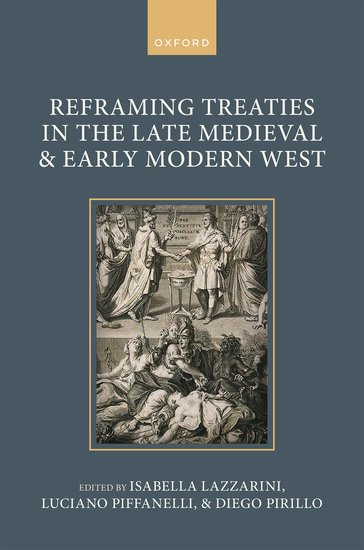
Edited collections on the history of diplomacy often face a familiar challenge: despite a common theme, individual contributions tend to move in different directions, leaving the reader with the impression of loosely connected case studies. Reframing Treaties in the Late Medieval and Early Modern West, by I. Lazzarini, L. Piffanelli and D. Pirillo, demonstrates the opposite. Drawing on the editorsʼ complementary expertise in diplomatic, legal, and intellectual history, the volume achieves a remarkable coherence not through chronological or geographical unity but through a shared methodological vision. Concepts such as political grammar, the documentary reconstruction of negotiations, and the shift from treaties as legal artefacts to peacemaking and peacekeeping as broader political processes provide the volume with a convincing interpretative thread.
As the editors make clear, the volume does not aim to write yet another history of peace treaties. Rather, it seeks to reconceptualise the treaty by moving beyond its conventional understanding as a self-contained legal instrument. Challenging the traditional emphasis on the final written agreement, the contributors reconstruct peacemaking as a heterogeneous process shaped by negotiation, documentary practices and multiple forms of political communication. The concept of political grammar serves as the volumeʼs central interpretative framework, directing attention to the conventions, practices and shared languages that made negotiation possible across different settings of the late medieval and early modern West. By shifting the analytical focus, the volume invites reconsideration of the most deeply rooted historiographical assumptions about diplomacy.
One of the strengths of the volume lies in the consistency with which this programme is pursued. The prologue demonstrates that treaties cannot be understood independently of the practices through which they were negotiated, produced, transmitted and interpreted. Drawing on a broad typology of diplomatic documents, N. Vigil Montes and I. Lazzarini convincingly shift attention from the treaty itself to the documentary practices surrounding it. Lazzariniʼs discussion of the Peace of Lodi is particularly persuasive in showing how later editorial traditions isolated the final treaty text from the wider documentary record that originally accompanied it, stripping away the material documenting the negotiations. Rather than approaching treaties as stable legal artefacts, both chapters reconstruct them as the outcome of complex documentary processes whose apparent coherence is the product of later archival, editorial and historiographical practices.
The second part, «Peacekeeping», brings attention to the political, social and confessional practices through which peaceful order was sustained within political communities. Rather than focusing on interstate diplomacy, the contributors show that peacekeeping depended on the continuous cooperation of rulers, institutions and communities. D. Hardy demonstrates how the Landfrieden of the Holy Roman Empire created a multilateral order maintained through arbitration, justice and the participation of territorial powers, while K. Hübner’s study of the Jihlava/Basel compacts reveals peacemaking as a long process of negotiating religious coexistence rather than a single act of settlement. F. Senatore’s study of the Kingdom of Naples turns to the ‟grey writings” of diplomacy – memoranda and working papers – to reconstruct the provisional and evolving character of negotiation, often more clearly preserved than in the final agreements themselves. H. Speich offers a particularly engaging perspective on the Swiss Confederation, demonstrating how peace was sustained not through formal settlements alone but through the everyday practices of mediation, renewal and confirmation that enabled political cohesion across the Alpine territories. B. Sandberg’s analysis of the Edict of Nantes, finally, offers an important counterpoint by demonstrating how an agreement long interpreted as a landmark of religious toleration also reveals the fragility of peace when political settlements failed to overcome confessional polemic and violence. These chapters redefine peacekeeping as a process of governance, in which peace depended not simply on agreements between rulers but on their constant negotiation, implementation and acceptance across society.
The third section, «Peacemaking», extends the inquiry beyond the internal dynamics of peacekeeping to the negotiation of peace across political, religious and cultural frontiers. It challenges conventional assumptions about diplomatic agreements by demonstrating that peacemaking relied on practices, documents and relationships that extended well beyond the formal treaty’s conclusion. M. Ouerfelli’s study of the agreement between Pisa and the Marinids reconstructs a form of commercial diplomacy shaped by multilingual exchanges and distinct chancery traditions, while exposing the methodological limits created by the uneven survival of documentary evidence. Turning to the Hundred Years’ War, D. Green shows how peacemaking could fail not because negotiations proved impossible, but because political elites often lacked the incentive to end warfare despite mounting social and economic pressures from below. F. Bauden’s study of Mamluk diplomacy demonstrates that within the legal traditions of the medieval Islamic world, truces, safe-conducts and commercial privileges fulfilled diplomatic functions without taking the form of reciprocal or permanent treaties, while F. Caprioli, examining the Ottoman-Habsburg rivalry centred on Algiers, develops this argument through his concept of ‟invisible treaties”, showing that stable relations could rely on unwritten understandings, mutual trust and the preservation of the status quo. Although this deliberate expansion of the category of treaty is among the volume’s most stimulating interventions, it also raises the question of its analytical limits. R. Claerr presents the Treaties of Cateau-Cambrésis as moments within continuing negotiations rather than definitive settlements, while J. Watkins, through the failed Bristol negotiations of 1575, extends the concerns of the New Diplomatic History to unsuccessful peacemaking. These contributions confirm that the volume’s principal concern lies less with treaties themselves than with the diverse practices through which peace was negotiated, implemented, maintained, or deliberately left unrealised.
The fourth part, «Intersections», marks a further stage in the volume’s argument by moving from the practices of peacemaking to the legal, intellectual and ethical traditions through which peace was conceptualised. J. Benham and D. Fedele demonstrate that the normative languages of peacemaking long predated modern international law. Benham reconstructs a polycentric legal order in which treaties actively created legal norms, while Fedele shows how the ius commune provided a shared political grammar through which both war and peace could be understood as juridical categories. T. Hampton shifts attention to the temporal and representational dimensions of diplomacy, arguing that delay in ratification and legal fictions reveal peacemaking as an ongoing process rather than its formal conclusion. M. Valente returns to the Edict of Nantes to show how oblivion, forgiveness and raison d'état became instruments of reconciliation after religious conflict. S.G. Zeitlin and L. Piffanelli, in turn, demonstrate that peace itself was neither a fixed nor timeless concept. Through the political thought of Bacon and Leibniz, respectively, they reveal competing understandings of peace as security, ethical order and continual pacification rather than the absence of war. Their reflections invite comparison with the alternative legal and diplomatic vocabularies encountered earlier in the volume, reminding the reader that neither the concept nor the practice of peace possessed a universal form. D. Pirillo complements these reflections by examining negotiations with Native American communities, demonstrating how colonial encounters challenged European assumptions about diplomacy and political order. Collectively, these chapters show that peacemaking cannot be understood solely through diplomatic practice, but must also be situated within the legal, intellectual and ethical traditions that made peace imaginable. Their frequent excursions into contemporary debates are more than illustrative comparisons: they realise one of the editors’ central methodological ambitions by bringing historical scholarship into a productive dialogue with questions more commonly associated with International Relations. At the same time, they prepare the reader for J.O. Newman’s epilogue, which turns from the history of peacemaking to the historiographical legacy of Westphalia and its enduring influence on modern understandings of international order.
Rather than approaching treaties as self-contained legal instruments, the volume reconstructs peacemaking and peacekeeping as dynamic processes unfolding through successive negotiations, encounters, documentary exchanges, legal argumentation and acts of implementation over extended periods. Not every reader will be equally convinced by all aspects of this conceptual expansion, particularly where the category of the treaty is stretched beyond its conventional boundaries. Yet precisely this willingness to challenge established categories makes the volume an important contribution to the NDH. It deserves to become a point of reference not only for future research on medieval and early modern peacemaking, but also for broader debates on diplomacy, political communication and the historical foundations of contemporary international order.

ARO
Annali.Reviews.Online
About us
Team
Archive
Contacts
Submission guidelines
Code of Ethics
Privacy
Partners