
Reviewer Una McIlvenna - Australian National University | Canberra
Citation

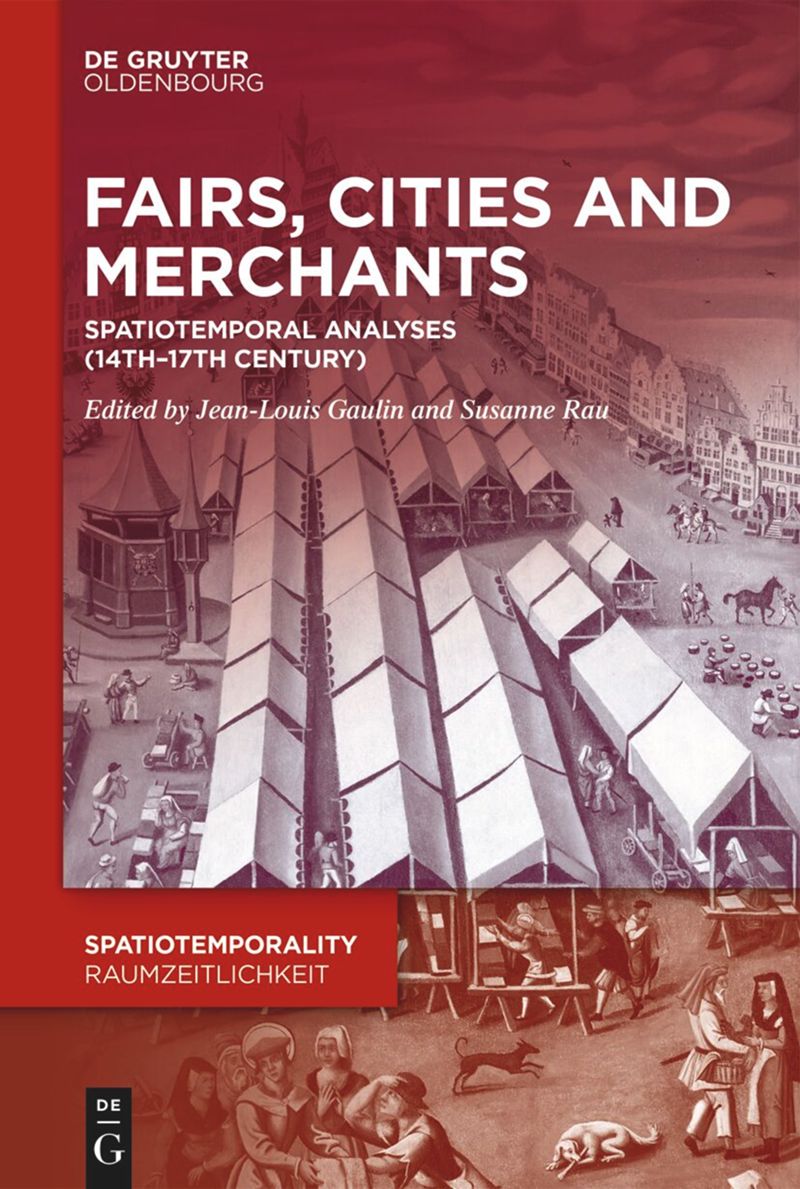
Throughout the high to late Middle Ages and up to the modern period, fairs were central in the development of the European economy and especially in the trans-regional exchange of goods. Fairs played a crucial role by mediating in trade, payments, and commercial communication between merchants and their goods in distant lands as well as with local merchants and consumers. At fairs, traders could learn about products, establish contacts, and build up the trust that underpinned the exchanges which allowed them to negotiate debts and settle accounts, often using complex financial instruments. Yet, despite their often-immense size, their location in the city centre or close to it, their integration into local cultural life, and the fact that they were (at least) an annual fixture in the calendar, fairs are an often-overlooked historical subject.
Now, the French-German research project Configurations of European Fairs. Merchants, Objects, Routes (1350–1600) (CoMOR) has researched the relations between space, time, and social connections in relation to the commercial exchanges at fairs, offering an edited volume of 17 essays and an accompanying database encoded with historical social and exchange networks founded on over 3,000 historical geographic coordinates (https://fairs-in-history.huma-num.fr). The project is centred on France, southern Germany, and northern Italy, with extensions into neighbouring economic and cultural regions. It covers the time period from the decline of the old fair systems at Champagne around 1320, through a cycle dominated by the fairs at Lyon, to the decline of the fairs at Besançon around 1630. The volume is divided into five sections: «Creating, defining, and attending fairs», «Credit and financial techniques», «Merchants at fairs», «Europe and beyond: time and space of fairs», and «Presentation of the CoMOR website/database».
The introduction by the editors, Jean-Louis Gaulin and Susanne Rau, argues that fairs provided certain functions: commodity trading, financial exchange, and state financing (where bankers provided loans to monarchs and other rulers). Goods were rarely paid for directly; instead, the purchase, delivery, and financing of goods traded at fairs took place at different times, requiring bills of exchange and a complex system of credit across international borders. Rulers offered significant incentives to traders and merchants through privileges which offered lucrative tax exemptions in order to showcase their cities, as explained by Ulf Christian Ewert on the granting of privileges by sovereign rulers in the Holy Roman Empire between the fourteenth and sixteenth centuries. While all of this is true, the entire volume ignores the social and cultural aspects of fairs, apart from a brief mention on page 22, to focus entirely on the commercial aspect of them.
Another point made in the introduction which is echoed in several of the chapters is that there were a multitude of terms in multiple languages used for fairs by contemporaries (market/mercato, fiera, bazaar, nundinae, Messe, etc) that were used interchangeably, and so it is a challenge to determine what exactly the event is that is being referred to in the historical record. The authors of the volume seem to assume that ‟fair” refers only to a place where major financial deals are made: Markus Denzel, in his final chapter on fairs in Eastern Europe, says that they lacked «two essential characteristics of fairs …[they] would not have represented a money or capital market or even a central element of state financing» and «in none of these markets was trade between merchants the dominant one, but rather between wholesalers and retailers or even end consumers.» That these two financial aspects are the only characteristics of fairs would be news to early modern historians who study the major fairs of London or Paris, for example, which were both hubs for long-distance trade AND major social and cultural gatherings. The volume is therefore valuable for anyone studying economic history, but less so for social and cultural historians of fairs.
Despite the title promising «Spatiotemporal Analyses», only a few chapters deal with the dates and times of fairs. From the twelfth century, fairs had operated on well-timed calendars (often based on religious holidays), as explained by Nicolas Sarzeaud who reveals the connections between fair dates and the exhibition of holy shrouds visited by pilgrims. Susanne Rau analyses the travel book and autobiography of a Basel merchant who visited multiple fairs, proposing a rhythm analytical approach to analysing fair dates: which fairs did he choose to visit and why? How did he get there and how long might it take? As the timing of fairs promoted specific regions, there was constant competition and disputes between different cities about the conflicting dates of fairs, which usually involved petitions to ecclesiastical and lay rulers.
There is some interesting prosopographical work done in multiple chapters: Ezio Claudio Pia examines the pan-European impact of the merchants of Asti in Piedmont, Clément Lenoble follows the Florentine Pazzi family at the Lyon and Geneva fairs, and Pauline Gomes examines the relocation of the Pietraviva family from Chieri in Piedmont to Lyon, where they became known as Pierrevive and were active in the import of spices. These chapters are useful for understanding the origins of the substantial Italian financial backers of the French crown in the late medieval and early modern period. As well as these studies of Italian merchants and bankers who made an impact in France, Marta Gravela explores the French Lyon merchants who helped to shape the early fairs. Other chapters deal with the much bigger players on the financial markets: Jean-Louis Gaulin explores how the court of Savoy was well connected to commercial networks as well as to the credit markets via the Geneva fairs, using trusted dealers to carry out their operations. Meanwhile, Armand Jamme argues that the Roman Curia, a powerful economic player in long-distance trade, used the fairs to collect church taxes throughout Europe.
Some chapters explore the logistics of the financial markets at fairs: Heinrich Langʼs study of several of the Salviati familyʼs Libri di fiera reveals the predominance of payments via bills of exchange and explains their use. Relatedly, Matthias Baumgartl analyses how the merchants David Gauger at Augsburg and David Wagner at Bolzano sent agents to trade fairs for bill of exchange redemption dates as well as to obtain access to capital markets. In his study of an early form of exchange rates, Claudio Marsilio focuses on the written and printed exchange lists, known as listini, to explain how traders and bankers could keep track of the changing values of currencies across Europe. This was a fascinating exploration of what was a first attempt at integration of the European monetary and financial markets in the early modern period.
The three chapters towards the end examine fairs outside the boundaries of the project: as well as Denkelʼs chapter on Eastern European fairs, Boglárka Weisz examines the emergence of a new trade route which connected the Rhineland (Cologne) with Hungary from the perspective of the merchant groups. François Gipouloux highlights the prevalence of the rural fairs and the timing and duration of temple fairs in Late Imperial China.
The volume is in English which, given the dearth of native speakers of the language on the project, should require publishers to pay closer attention to translation and editing. However, a couple of the chapters give the sense that they were not edited by a native speaker, and some give the impression that there was no copy-editing done (for example, on page 228, where two sentences are immediately repeated). Additionally, some quotes are provided in the original language in the body of the text without translation in the footnotes (page 128), while others are in English in the body, sometimes with the original text in the footnotes (page 86, 373), sometimes not (page 14). Such issues should be prevented by proper copy-editing.
Overall, this is a volume and database built on painstaking archival research with applications in economic history, geography, demography, network theory and analysis, political economy, and digital humanities. Its database, which promises to be continually updated as new research comes in, promises to be of great value in all of these fields.


ARO
Annali.Reviews.Online
About us
Team
Archive
Contacts
Submission guidelines
Code of Ethics
Privacy
Partners