
Reviewer Jasper Heinzen - University of York
Citation

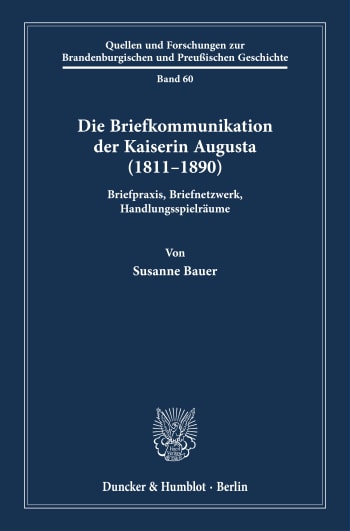
Along with the authors of the other works reviewed in this forum, Susanne Bauer belongs to a new generation of historians that study royals to challenge old certainties about German high politics in the nineteenth century.[1] Her book, Die Briefkommunikation der Kaiserin Augusta (henceforth referred to by the acronym BKA), seeks to relativise the paramountcy of Bismarck by examining the agency of Queen (later Empress) Augusta, the consort of the first ruler of unified Germany. In contrast to the Iron Chancellor or her husband, Augusta held no defined office of state. To illuminate the neglected role of female monarchs, Bauer explores the informal influence Bismarck’s outspoken critic wielded via her extensive international network of contacts. Throughout her life, she exchanged tens of thousands of letters with 489 known correspondents. This review will first discuss Bauer’s methodology and secondly the conclusions she draws about the reach of Augusta’s interventions before taking stock of the book’s contribution to the literature.
BKA began life as a DFG-funded PhD dissertation under the supervision of Christian Jansen at the University of Trier. The empirical basis of BKA are 22,096 letters from a truly impressive range of archives, libraries, museums, and edited collections. This rich vein of source material, which encompasses the years 1817 to 1890, has been forensically mined in every conceivable way. Key criteria for the organisation of the meta data are the names of the recipients and the provenience, place, date, format, and method of dispatch of the correspondence. These details offer revealing insights not only into the composition of Augusta’s social circle but also the materiality of letter-writing. Types of paper varied according to the recipient. High quality and elaborately embossed stationery marked high status. Even the use of space offered clues about the correspondents’ relationship. Greater economy (for instance, through cross-writing) implied familiarity, whereas empty pages were reserved for formal interactions between individuals of unequal rank. Such subtle markers of difference were driven home by a broad catalogue of salutations across multiple languages. Of the extant corpus of Augusta’s correspondence, 57 percent was in German, 42 percent in French, and 0.3 percent in English. The prominence of French reflected her family of origins’ connections to the Russian court, although, counterintuitively, Augusta was quite the anglophile in her political proclivities. Bauer furthermore assiduously delineates the purposes for which letters were written. They ran the gamut from sentimental private letters, which served to cement family bonds with enclosed locks of hair and dried flowers, to memoranda with which Augusta tried to influence the decisions of her husband and government ministers. Yet, no matter how intimate the correspondence, Bauer notes the near impossibility of separating the queen from the sibling, cousin, or friend. Royal correspondence was seldom safe from the prying eyes of spies.
Close to a third of BKA is taken up by the practical aspects of letter-writing. The remainder of the monograph delves into the particulars of Augusta’s network. It may come as a surprise that she and Wilhelm sent each other no fewer than 5,800 letters. They disagreed on key political issues like Bismarck’s appointment to the Prussian premiership in 1862, and written position statements proved essential to keeping the marital peace. Beyond her immediate family, Augusta also kept in touch with 39 (former) reigning dynasties. The solidarity of Verwandtschaftlichkeit (lived family sense) gave these exchanges a special intensity.[2] Although further examples would have been welcome to back up the point, Bauer provides tantalising evidence of Augusta’s «central function in the royal correspondence network» (p. 311). The queen-empress transmitted news and shared with relatives her opinion on certain subjects. For instance, during the Luxembourg Crisis of 1867 she successfully worked behind the scenes to torpedo the sale of the grand duchy to France. The dialogue between high aristocratic equals stood apart from the etiquette that dictated other forms of communication.
This self-conscious nod to the feudal society of estates contrasted with Augusta’s openness to reform in other areas. Against conservative opposition she demanded that her son be educated as a constitutional monarch and made sure to stay abreast of the latest political developments. To this end she maintained a regular correspondence with parliamentarians, diplomats, civil servants, jurists, academics, and clerics. Many sought her patronage, but Augusta, too, knew how to recruit others for her preferred causes. The issues she cared about included the termination of the Prussian state’s war on the Catholic church in the Kulturkampf era. As the daughter of a Russian grand duchess who refused to convert to the Protestant faith, Augusta favoured tolerance. Just as importantly, she became a determined advocate of humanitarian enterprises, which extended female royals’ traditional interest in sick and poor relief. Here she could boast numerous achievements such as the establishment of Patriotic Women’s Associations under the umbrella of the Red Cross, technical improvements in wartime surgery, and the appointment of a commission to overhaul the military medical service. It is in these areas that the parallels with Markert’s and Sterkenburgh’s biographies of Wilhelm I. are most apparent. Bauer demonstrates that Augusta, like her spouse, doggedly promoted the consolidation of a strong Prussian-led nation-state. She obliged ministers and their wives to attend audiences, where she would impress ideas on them, and virtually strong-armed a reluctant minister of war, Albrecht von Roon, into adopting her proposal for the independent commission on military healthcare reform. However, Augusta’s activism remained more low-key than her husband’s, because in public she was content to conform to the prevailing ideal of female apoliticism.
Although the royal republic of letters has been popular with historians of monarchy for a long-time, the depth of BKA’s intellectual engagement with this subject sets a new standard of comprehensiveness. The monograph’s attention to nuances of etiquette and the reach of Augusta’s network sheds light on the way in which female consorts exerted power as dynasts and women, despite – or perhaps because of – their vaguely defined constitutional position in the state. However, BKA’s detail-oriented approach is both its greatest strength and weakness. The aggregate of its claims does not easily add up to a sustained argument. On putting the book down, the reader is left with questions about the relationship of Augusta’s shrewd networking to the wider historiography on monarchy. New scholarship in the last three decades has at length investigated the creative strategies royals (as well as lesser aristocrats) developed to ‟stay on top” in the nineteenth-century’s dawning age of mass democracy. There would have been scope to connect Augusta’s informal clout to debates about the growing importance of monarchical soft power. Although crowned heads retained significant prerogatives and benefited in other ways from their considerable symbolic capital, they came to realise that their survival depended as much on Machiavellian acumen as the ability to charm their subjects. In this balancing act they placed themselves at the head of dominant cultural forces, which they infused «with their own personal and institutional charisma.»[3]
We catch glimpses of this symbiosis, but BKA could have followed up the implications more systematically. For instance, it is left unsaid how the virtuous causes Augusta championed play into the grander Hohenzollern vision for national unification. The stresses and strains of Prussia’s merger into the Reich remain strangely marginal to Bauer’s otherwise wide-ranging analysis. Secondly, more explicit comparisons could have amplified her findings. Against the backdrop of Frank Lorenz Müller’s extensive work on royal heirs, it seems worth asking to what extent Augusta’s messaging complemented or deviated from that of her son Crown Prince Friedrich Wilhelm, whose constitutional standing was similarly ambiguous. Müller has suggested that the liminality of certain members of the royal family was far from accidental. Untainted by the political decisions of the sovereign they had the autonomy to cultivate the monarchy’s soft power.[4] Yet if the heir to the throne courted popularity with the implied promise of change in the future, what value did consorts bring to the task? A closer look at Karen Hagemann’s and Eva Giloi’s works on the gendered division of labour in the Prussian royal family would have provided useful context.[5]
However, these lacunae merely highlight the relevance of Bauer’s painstaking research for current areas of enquiry. The author breaks down her large source base in a concise and well-structured manner. BKA and the other books in this forum succeed in showing that even a subject as seemingly conservative as the perpetuation of royal power offers fresh perspectives on the reconfiguration of political legitimacy in the nineteenth century. Like the Sicilian nobleman Tancredi in Giuseppe Tomasi di Lampedusa’s novel The Leopard, the Hohenzollerns understood that «If we want things to stay as they are, things will have to change.»[6]
[1] Luisa Götz, Tagungsbericht: HT 2025: Monarchische Macht im 19. Jahrhundert. Kaiser Wilhelm I. und Kaiserin Augusta im Lichte neuer Forschung, in «H-Soz-Kult», 25.10.2025, https://www.hsozkult.de/conferencereport/id/fdkn-158256.
[2] On this concept, see Silke Marburg, Europäischer Hochadel: König Johann von Sachsen (1801-1873) und die Binnenkommunikation einer Sozialformation, Berlin, Akademie Verlag, 2008, pp. 149-150.
[3] Frank Lorenz Müller, ‟Winning their Trust and Affection”: Royal Heirs and the Uses of Soft Power in Nineteenth-Century Europe, in Frank Lorenz Müller, Heidi Mehrkens (eds.), Royal Heirs and the Uses of Soft Power in Nineteenth-Century Europe, London, Palgrave Macmillan, 2016, p. 6.
[4] Frank Lorenz Müller, Royal Heirs in Imperial Germany: The Future of Monarchy in Nineteenth-Century Bavaria, Saxony and Württemberg, London, Palgrave Macmillan, 2017.
[5] Karen Hagemann, A Valorous Volk Family: The Nation, the Military, and the Gender Order in Prussia in the Time of the Anti-Napoleonic Wars, 1806-15, in Ida Blom et al. (eds.), Gendered Nations: Nationalisms and Gender Order in the Long Nineteenth Century, Oxford, Berg, 2000, pp. 179-205; Eva Giloi, Monarchy, Myth, and Material Culture in Germany, 1750–1950, Cambridge, Cambridge University Press, 2011.
[6] Giuseppe Tomasi di Lampedusa, The Leopard (tr. by Archibald Colquhoun), London, Vintage Publishing, 2007, p. 19.


ARO
Annali.Reviews.Online
About us
Team
Archive
Contacts
Submission guidelines
Code of Ethics
Privacy
Partners