
Reviewer Kateryna Burkush - Università di Torino
Citation

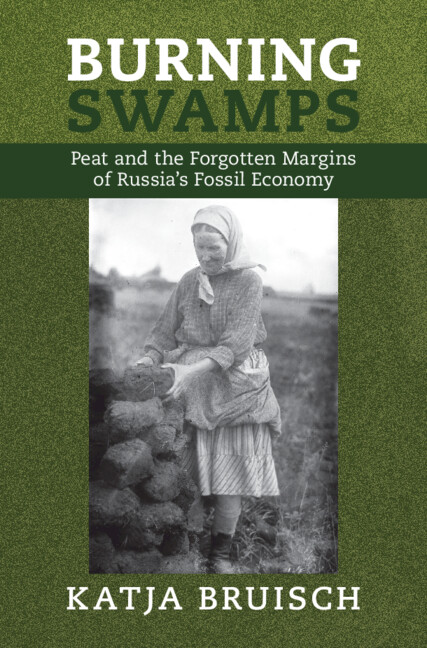
Peat, a subterranean layer of compressed organic matter that can be used as fuel, did not enjoy as much historians’ attention as other fossil fuels that powered the age of industrial modernity, such as coal and oil. With Burning Swamps: Peat and the Forgotten Margins of Russia’s Fossil Economy, Katja Bruisch addresses this omission, arguing for a reconsideration of peat’s place in an industrial economy. The book undermines the notion that peat was a «traditional», or non-industrial fuel (p. 93), showing that the history of peatlands exploitation is integrated into the development of the Russian fossil economy – starting as an industrial endeavor in the late nineteenth century and consolidating institutionally and infrastructurally during the Soviet period. While statistically marginal in the fuel consumption rates of a huge economy, peat became an important resource for generating electricity in the 1920s and remained in industrial demand until the last Soviet decade. Paying close attention to «the margins», Burning Swamps offers a view of an industrial economy that relies on diverse sources of energy, and shows that the recognition of such diversity provides a sharper focus on the environmental and social history of a modern society.
The main body of the book consists of three parts, each containing two chapters. The first two chapters reconstruct the historical path of peat’s incorporation into the Russian «industrial metabolism». In Chapter 1 (Appropriation), the author shows how Russian imperial elites developed a vision of peat as an economically promising natural resource. The state, which owned vast peatlands, was at the forefront of increasing the use of peat as fuel. This was motivated by three main reasons: protecting forests from overcutting, bolstering industrial growth, and revenue seeking through leasing wetlands to entrepreneurs for peat extraction.
Peat’s use for industrial purposes grew in the late nineteenth century. But, as the author shows, large-scale systematic extraction only started after the October Revolution. Both the Russian Empire and the Soviet Union sought cheap energy for economic growth, but the Bolsheviks, having nationalized all land and removed political opposition, obtained full power over the use of the land’s resources. Chapter 2 (Mobilization) drives the book’s argument forward by showing the importance of peat to the Soviet electrification project, which was both a symbol of and a means to social progress. Engineers saw peat as a «local» fuel with high potential to supply energy for strategically placed electric power plants (p. 60). From this chapter on, Bruisch integrates a regional perspective into her analysis, occasionally bringing into focus the Meshchera Lowlands to the east of Moscow as a localized case study within a broader narrative. In the new era of electricity, the Meshchera Lowlands, rich in peat, became an «internal resource frontier» of the capital and the surrounding enterprises. The «regional paradigm», adopted by the author, proves to be a methodologically rewarding choice. On the one hand, it questions the notion of «marginality» of peat, showcasing its vital importance on the scale of a region. On the other hand, it allows the author to explore «a myriad ways in which industrial development integrated places, people, and things […] as interconnected elements of a shared political ecology» (p. 68).
Chapter 3 (Exploitation) addresses one crucial element of that «integration»: labor. During the late imperial and a part of the Soviet period, peat production relied on hundreds of thousands seasonal workers who migrated between their villages and peat production sites. The chapter broadens our knowledge about migrant laborers in the Soviet Union, showing, in particular, that the cheap costs of labor in peat extraction were maintained through gendered division of labor. Like in agriculture, women performed physically taxing but low-skill jobs, such as peat drying and stacking, while men operated machinery. Manual workers faced social inequality in exposure to work-related accidents in precarious, poorly secured peat environments, and gendered differences aggravated these risks. Starting from the 1950s, technological changes in peat extraction eliminated the need for a seasonal workforce, and discourses around welfare replaced the austerity of fast-paced industrialization of the 1930s. Chapter 4 (Transformation) traces the technological transformation of space explaining how transport and drainage infrastructure turned peatlands into an industrial landscape. After Stalin, permanent housing replaced barracks, and welfare infrastructure – hospitals, schools, kindergartens – improved the daily lives of now-permanent workforce of peat trusts. Moreover, intertwined with socialist patriotic myths and rituals, peat production became connected to both the Soviet project of modernization and the individual and collective lives of workers. Together, they fostered a shared sense of belonging.
However, the book cautions against a linear narrative of progress, revealing the social and environmental ambivalences of industrial transformation and exposing the power hierarchies that it produced. Chapter 5 (Irritation) shows that human intrusion into the wetlands resulted in environmental hazards. Each peat extraction method exacerbated ecological vulnerabilities. The hydropeat method facilitated the spread of malaria-transmitting mosquitos, which caused an epidemic in the 1920s. After the mechanized milled peat extraction method was implemented, extracted stacked peat became a fire hazard because of its propensity to self-inflammation. Fires became a reoccurring threat and a constant management issue. Chapter 6 (Revaluation) addresses long-term social and environmental consequences and challenges that arose from extractivist policies, including local peat scarcity, devastated landscapes, and wildfire hazards due to climate change. The chapter examines the changing environmental paradigm of late Soviet socialism, pointing out the contradiction between lingering productivism, the rising awareness of the consequences of expansive peat extraction, and the emerging new vision of wetlands as ecosystems in need of protection (p. 215). From the angle of social history, the chapter also traces the transformations that peat industry had to face as peat lost its relevance as fuel due to transition to other sources of energy, in particular, natural gas. It addresses the consequences of the political changes, the economic crisis, and deindustrialization for the communities whose livelihoods used to be tied to the peat industry and the social infrastructure built around it. The chapter bridges into the post-Soviet period, demonstrating the lasting impact of past industrial intrusions into the peatlands and linking it to the global trajectory of environmental emergency.
Combining a wide variety of sources – bureaucratic documents, specialized publications, literature, and even folklore – the book succeeds in delivering a complex analysis of industrial peat production over «the Soviet century» and beyond in a clear, engaging, and sympathetic narrative, as attentive to economic balances as it is sensitive to cultural perceptions. The central subjects of each chapter are contextualized within broader themes of the Russian nineteenth and twentieth century history, which not only integrates peat into the history of the Soviet fossil economy from social, economic, and environmental perspectives, but also makes the book relevant to diverse groups of scholars.


ARO
Annali.Reviews.Online
About us
Team
Archive
Contacts
Submission guidelines
Code of Ethics
Privacy
Partners