Reviewer Mikko Immanen - University of Helsinki
Citation

Over the past half century, countless studies have explored Germany’s and Italy’s post-World War II struggles to come to terms with their Nazi and Fascist pasts. A particularly well-researched area has been West Germany’s successful democratization in the 1950s and 1960s, as numerous historians have sought to cast light on the process of ‟recivilizing Germans”.[1]
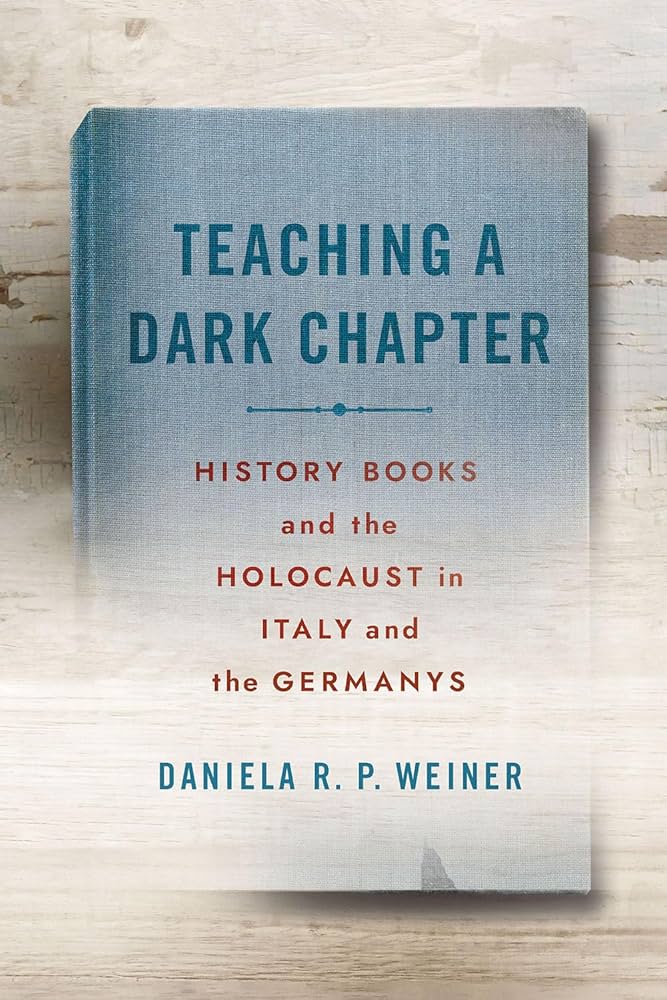
Daniela R.P. Weiner’s Teaching a Dark Chapter: History Books and the Holocaust in Italy and the Germanys approaches the phenomenon of ‟reeducation” through the lens of history textbooks used in (West and East) German and Italian schools in postwar decades. The study’s main objective is to examine how schoolbooks – which only recently had served as channels of totalitarian indoctrination – sought to and succeeded in educating young Germans and Italians of their countries’ dictatorial pasts and complicity in the Holocaust.
Weiner’s book has three key characteristics. First, the very focus on history textbooks; in earlier scholarship on postwar educational reform, much more attention has been given to other topics such as teacher training. Second, the book’s comparative approach; while studies on textbooks in Italy and the two Germanies have been available before, Weiner’s is the first one to compare all three. Third, the book’s aim to write «an integrated history of the textbook» (p. 5); it does not focus solely on what was said in textbooks, but addresses in equal measure their ‟production” (debates and power struggles among Germans, Italians, and the Allied that facilitated new textbooks’ coming into being in the first place) and ‟reception” (among teachers, politicians, and parents, which again impacted the planning of subsequent series of books).
Teaching a Dark Chapter contends that the history of postwar textbooks was characterized not by a steady linear development but by three abrupt ‟flashpoints”, exceptional historical periods that profoundly impacted the way textbooks were thought of and written. These three turning points also serve as the tripartite chronological structure of Weiner’s study.
The first part focuses on the Allied occupation of Italy (1943-1946) and Germany (1945-1949) and the introduction of first new textbooks, a process complicated by paper shortages and balancing acts that the Allied had to strike between their resolve to control the reeducation process and trust the occupied nations’ initiatives to reeducate themselves. Weiner shows that the occupation of Italy served as a testing ground that allowed the Allied to learn from their mistakes and better prepare for their looming work in Germany. Another interesting observation concerns merits of textbooks adopted in Germany’s eastern zone of occupation. Although hampered by the Communist dogma of heroic worker resistance, these textbooks, unlike their Western counterparts or those used in Italy, openly discussed Nazi atrocities and their Jewish victims.
In the second part, Weiner shifts her focus on a far less well-known moment in the story of history textbooks, namely the aftermath of the transnational ‟swastika wave” in 1959. This unnerving surge of neo-Nazism forced Italian and German educators to ask themselves whether the first postwar textbooks had been that successful after all. In Italy and West Germany, this soul-searching resulted in new, more critical textbooks. These placed special emphasis on previously neglected teaching of ‟contemporary history” and discussed, virtually for the first time, the Jewish victims of the Holocaust, something that East German textbooks had done already over a decade earlier.
In the third part, the book analyzes diversification of the Holocaust ‟memory landscape” in the 1970s and 1980s, a phenomenon galvanized by entry into the public sphere of such widely resonating cultural products as the 1978 US miniseries Holocaust. If in the late 1950s and early 1960s textbooks had been genuine «drivers» of change in Holocaust memory, in the following decades they lost this role to other media (p. 168). During this time, not much changed in the established textbook narratives about the past, and the Holocaust education inside the classroom was advanced more by new pedagogical practices than textbooks themselves.
The main achievement of Teaching a Dark Chapter, in my view, is its compelling attempt to challenge the myth of 1968. According to received wisdom, before the 1968 student revolts in West Germany and Italy practically no steps forward had been taken in educational coming to terms with the past (Vergangenheitsbewältigung). Through a careful examination of textbooks written in the wake of the 1959 ‟swastika wave”, however, Weiner can plausibly suggest that the student radicals of the late 1960s owed their «increased rhetoric about the Fascist past» not least to the improved history textbooks they had earlier been exposed to at school (p. 10).
[1] Konrad H. Jarausch, After Hitler: Recivilizing Germans, 1945-1995, Oxford, Oxford University Press, 2006.

ARO
Annali.Reviews.Online
About us
Team
Archive
Contacts
Submission guidelines
Code of Ethics
Privacy
Partners