
Reviewer Brian Sandberg - Northern Illinois University
Citation

Northern Italy represented a site of dynastic rivalries and a frequent war zone throughout the early modern period. King Charles VIII of France (r. 1483-1498) personally led an invasion of Italy in 1494, touching off the long Italian Wars (1494-1559), as French, Imperial, and Spanish armies sought to dominate the Italian peninsula. Emperor Charles V (r. 1519-1556) and King François I of France (r. 1515-1547) vied for control of Milan in the 1510s and 1520s, expanding the wars into a broader set of Habsburg-Valois Wars waged in Italy, northern France, Flanders, and Germany. Later, King Henri IV of France (r. 1589-1610) founded the Bourbon dynasty and engaged in war against Savoy (1601). His son and successor, King Louis XIII (r. 1610-1643) sponsored military interventions in Valtellina (1620-1626) and Monferrato (1628-1630) before declaring war on the Spanish Monarchy in 1635, effectively beginning a Franco-Spanish War (1635-1659), which was fought significantly in northern Italy, paralleling the Thirty Years’ War and outlasted it. King Louis XIV (r. 1643-1715) continued this legacy of Bourbon dynastic ambitions and French royal ambitions in northern Italy.
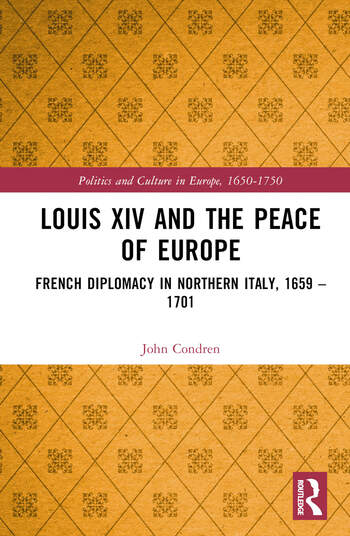
John Condren’s Louis XIV and the Peace of Europe: French Diplomacy in Northern Italy, 1659-1701 considers how i piccoli stati (small states) in northern Italy navigated the Bourbon-Habsburg rivalry during Louis XIV’s long reign. Northern Italy remained a major theater of warfare during most of Louis XIV’s many wars, and especially during the Nine Years’ War (1688-1697) and the War of Spanish Succession (1701-1714). Spanish monarchical forces maintained viceregal rule over the Kingdom of the Two Sicilies and the Duchy of Milan, as well as a broader “Spanish hegemony” over much of the Italian peninsula, despite repeated French attempts to undermine or disrupt it. Louis XIV often pursued aggressive diplomatic and military policies to bully smaller states in northern Italy, but he also provided protection and mediation to Italian princes.
Condren appropriately utilizes an analytic framework of patron-client relations to examine Louis XIV’s complex and changing relationships with the Italian princes in northern Italy. The book’s analysis focuses especially on three small dynastic principalities: the Duchy of Parma and Piacenza (ruled by the Farnese), the Duchy of Modena and Reggio (Este), and the Duchy of Mantua and Monferrato (Gonzaga-Nevers). Condren situates these small states as operating between larger Italian states such as the Duchy of Savoy-Piedmont, the Republic of Genoa, the Grand Duchy of Tuscany, the Republic of Venice, and the Papal States. Members of the Farnese, Este, and Gonzaga-Nevers dynasty also had to negotiate carefully with the powerful Spanish, Imperial, and French monarchies that sought to dominate Italian politics.
Part I of Louis XIV and the Peace of Europe examines the culture of diplomacy, mediation efforts, and royal demands during Louis XIV’s early reign in the 1660s and 1670s. Condren examines diplomatic networks and information exchanges developed by resident ambassadors, envoys, and other agents of dynastic states. This analysis builds on the work of Filippo de Vivo, Paul Dover, John C. Rule, and Ben S. Trotter to examine the circulation of information, news, and rumors among various diplomatic agents (pp. 17-37). French agents promoted the idea of a pax gallica early in the Sun King’s reign’s by mediating dynastic claims and territorial disputes among Italian princes and their states. Louis XIV famously claimed to be «arbiter of war and peace» in a print of 1676 (p. 10), hoping to act as patron to Italian princely dynasties and undermine Spanish and Imperial influence in the peninsula. Yet, this royal propaganda belied the Sun King’s desires to dominate northern Italy, and perhaps all of Europe. Meanwhile, Italian princely dynasties and their agents sought to promote their territorial claims, defend their dynastic interests, and navigate the intense Franco-Spanish rivalry. In chapter 2, Condren provides the example of Vincenzo Striggi-Gonzaga, who conducted careful diplomacy at the court of Louis XIV in the 1660s, seeking to secure the duke of Mantua’s control of the citadel of Casale, a major fortification in Monferrato (pp. 55-58). Condren focuses chapter 3 on the Corsican Guards Affair of 1662-1665, which resulted from a «vicious armed brawl outside the Palazzo Farnese» in Rome between the Pope’s Corsican Guards and French servants in August 1662 (pp. 72-73). This violence incident challenged the principle of diplomatic immunity, but also gave Louis XIV an opportunity to bully Italian princes and advance his political ambitions by aggressively threatening outright warfare.
Part II of the book focuses on Louis XIV’s aggressive policies in northern Italy in the latter decades of his reign. The Sun King relentlessly sought to acquire direct of control of the citadel of Casale (Monferrato), finally seizing it 1681 (pp. 110-113). The ways in which French forces maintained their hold on Casale and threatened the Italian princes in the Po River Valley, especially Vittorio Amedeo, Duke of Savoy-Piedmont. Louis XIV sent a French fleet to bombard Genoa in May 1684 and aggressively interfered in Italian dynastic affairs throughout the 1680s, further alienating many Italian princes (pp. 128-146). Chapter 5 shows how Louis XIV’s menacing attitude contributed to the formation of a broad European Grand Alliance against France during the Nine Years’ War (1688-1697). The Spanish occupation of Guastalla and their arrest of the abbé de Croissy demonstrated that Louis XIV could not protect his agents and clients in northern Italy (pp. 154-155). Condren demonstrates that Louis XIV’s attempts to act as a patron toward Italian princes had utterly failed. The Farnese, Este, and Gonzaga-Nevers dynasties were effectively «in the claws of the imperial eagle,» as Condren shows in chapter 6. In contrast, Vittorio Amedeo II, Duke of Savoy-Piedmont, asserted his power by joining the anti-French Grand Alliance in 1690 and fought against French forces in northern Italy, eventually seizing the key citadel of Casale in 1695 and then forcing Louis XIV to cede the fortress of Pinerolo, which had long served as a gateway for the French into northern Italy (pp. 156-159, 169-171). Condren emphasizes that the loss of these fortifications represented a strategic defeat and a massive blow to French prestige, demonstrating that «Louis XIV was incapable of dominating the principi padani» (p. 171).
Louis XIV and the Peace of Europe provides a brief overview of the War of the Spanish Succession (1701-1714), which broke out after Louis XIV’s grandson inherited the entire Spanish monarchy and its empire. Condren observes that «the War of the Spanish Succession witnessed a defeat for Bourbon policy, both French and Spanish, in northern Italy» (p. 187). However, it might have been interesting to see how the small states of northern Italy navigated the effective dynastic merger of the French and Spanish monarchies, opposed by another grand coalition under Imperial leadership. The book’s case studies of the Farnese, Este, and Gonzaga-Nevers dynasties offer new evidence on the small states in northern Italy, largely confirming recent interpretations by John A. Lynn, Guy Rowlands, Thierry Sarmant, Hervé Drévillon, and other historians who have emphasized the political and strategic costs of Louis XIV’s aggressive policies of intimidation against Spain, the Spanish Netherlands, the Dutch Republic, German principalities, and Imperial Austria. Condren concludes that «ultimately, Louis XIV’s failure to develop a roust and viable client system among the Italian princes, the geostrategic problems he encountered in other theatres of war and diplomacy, and the revival of Austrian Habsburg influence in Italy from the 1680s onwards, meant that, in the long run, geopolitical influence in northern Italy would not and could not be a priority for the French crown after 1713» (p. 190). Louis XIV repeatedly alienated potential clients and created new enemies, forcing his kingdom to fight against broad coalitions in major European wars. Louis XIV’s successive wars shattered any illusion of Louis XIV as a peacemaker in Italy or throughout Europe.


ARO
Annali.Reviews.Online
About us
Team
Archive
Contacts
Submission guidelines
Code of Ethics
Privacy
Partners